What Can Change in a Year for Investment Operations: The AI Mandate at InvestOps 2026

.avif)
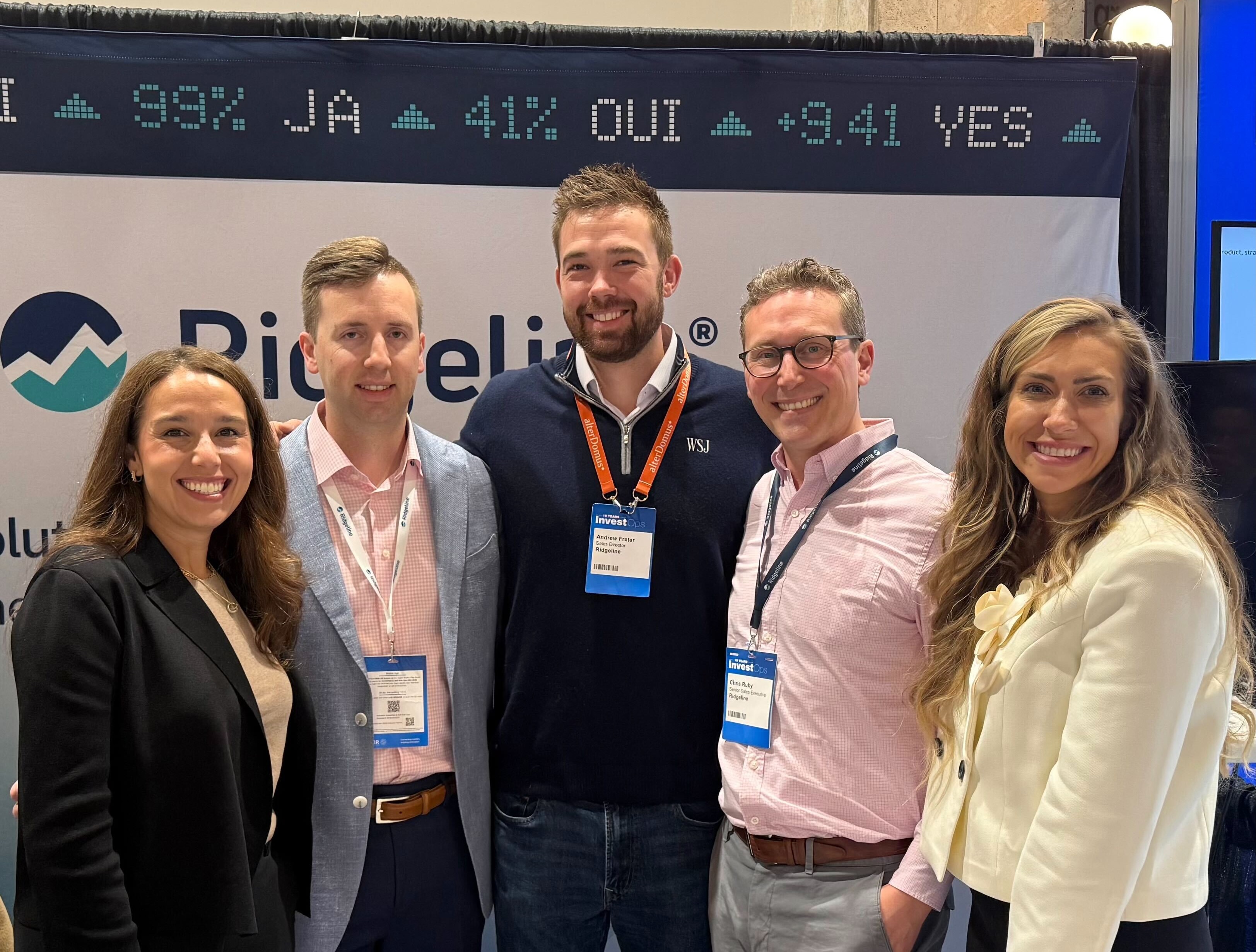
Last year at InvestOps, I was working for another company, observing Ridgeline from the sidelines. I watched the flurry of activity around the Ridgeline booth after the announcement of its first AI agents. It was a bold move at a time when most vendors were still talking about AI in broad terms or showing early experiments.
There were still questions about whether AI would make a lasting difference in how investment managers actually work, and the topic often surfaced in conversations with more skepticism than excitement.
But I bought into the vision and joined Ridgeline shortly thereafter. Fast forward a year and others are catching on too. Many attendees arrived at InvestOps 2026 with explicit AI mandates from their boards and executive teams. While the experimentation phase is far from over, it now sits under a directive to deliver. Firms need to show how AI will drive real, measurable value, and they need to do it quickly.
You could feel that urgency in the room. And it pointed to something bigger than AI itself. It highlighted a change in the attitude and agency of operations teams at investment management firms.
What’s Changed in Investment Operations
The downward pressure in this industry has remained consistent. Fee compression continues to stretch margins, firms remain interested in consolidation opportunities, private markets continue to capture interest from more investors, and that highly personalized client experience continues to be the differentiator that firms are most focused on.
These business problems have been at the forefront of industry leaders for several years, but what has changed is how managers are solving these challenges. AI has become the solution. In the 12 months since InvestOps 2025, it has completely shifted from skepticism to mandatory. It is even more of a requirement now that the next generation of investors and employees have entered this industry.
That sets the stage for the next phase in how firms need to evolve: intelligent operations.
Intelligent operations is essentially how asset managers create a 1+1=4 scenario. In an industry of professionals that seek compounding returns, operations leaders have realized that an AI operating platform is how they can turn their business unit into a profit center.
The AI Conversation Has Matured – and Intensified
The enthusiasm about AI isn’t what stood out most at InvestOps. It was the type of questions being asked.
Leaders are no longer debating whether AI works. They’re debating how to redesign workflows around it. Which processes should be agent-led? How do we formalize accountability when AI participates in decisions? How do we capture the “Why” to ensure LLMs have the necessary context? What changes are required to the data model and system architecture to support real-time intelligence? And how do we ensure every AI-driven action is transparent, explainable, and audit-ready?
But just because people are more knowledgeable about AI doesn’t mean there isn’t still FUD (fear, uncertainty, and doubt). That’s natural anytime a paradigm shifts.
I’d like to add one more F to that acronym: frustration.
People are seeing other firms achieve incredible results with AI and they’re asking themselves, “We have access to the same models, so why can’t we do that at our firm?” For example, one of the panelists at InvestOps shared that reconciliation used to take anywhere from 2-6 hours out of their day, but that they have now reduced that to 15 minutes with Ridgeline.
In contrast, after a later discussion on embedded AI operations with a prospective Ridgeline customer, the CIO turned to his Head of Operations and asked, “Why hasn’t our current vendor offered us any of this?” Unfortunately for them, the answer was that their current provider has not created an infrastructure that unlocks this for them.
These are the details that we set out to debate at InvestOps, and the conversations we had were immensely rewarding. Firms are shifting their responses from “It’s a matter of when, not if we invest in AI,” to “We need to evolve now or get left behind.”
The Role AI Should Play in Investment Operations
Many firms are starting their AI journey by using it as a smarter reporting layer. That’s understandable. It’s a safe place to begin. But it undersells what’s possible.
AI’s real impact in investment operations is in reshaping how work is coordinated, monitored, completed, and then scaled.
For decades, operations have relied on human vigilance to keep complex systems aligned. Reconciliation is a perfect example. Breaks don’t just appear neatly labeled. They surface across custodians, counterparties, internal books, and downstream reporting systems. They are then amplified, when you require batch updates to these downstream systems that may or may not recalculate your data.
Investigating them often requires stitching together structured data, emails, historical context, and institutional knowledge. When something unexpected happens, it can consume hours of senior attention, not because the team lacks skill but because the system lacks continuous intelligence. This also exposes key risks for the business with data timeliness, incomplete and inaccurate data, as well as key-personnel unable to take time off.
In reconciliation, well-orchestrated AI can:
- Continuously monitor positions, cash, and transactions across sources
- Detect anomalies in real time rather than at cycle intervals
- Generate root-cause hypotheses using historical break patterns
- Trigger next steps automatically within governed workflows
- Maintain a fully traceable audit trail of actions and decisions
In a similar way, operations can use AI to monitor trade lifecycle events, coordinate onboarding workflows, manage data exceptions, explain a compliance violation, and support corporate actions. You’re using technology to absorb complexity and create leverage.
When monitoring and follow-through become AI jobs, humans move up the stack. Operations teams shift from searching and chasing to interpreting, deciding, and improving. Technical capabilities become more accessible, judgement and human reasoning become the differentiator.
What You Need in Place: The Technology Foundation
This is where most firms are getting stuck.
AI can’t transform your operations if your technology foundation is legacy and fragmented. Most firms have data scattered across systems, workflows spanning email and spreadsheets, and lack key metadata to provide AI important business context.
You can’t AI-away legacy technology problems, or layer AI on top of existing processes. To enable true intelligent operations, you’ll need:
- A clean and consistent, unified data model. AI is most optimized when there is one source of truth.
- To be able to capture the "why." Metadata is extremely important for AI. Context is what speeds up the learning of these models.
- Explicit workflows where the system understands state, ownership, and completion, only possible when all employees have access to a single platform, and not license-based applications.
- Embedded intelligence operating inside the system of record, not adjacent to the system of record.
This is the foundation Ridgeline was built on. Ridgeline built a modern architecture that unifies front, middle, and back-office workflows around a real-time system of record with embedded AI. This enables investment managers to automate manual processes, collaborate across teams on a single data model, and absorb complexity without adding headcount.
Ridgeline Intelligent Outcomes (IO) is one example of what becomes possible when that foundation exists. IO combines unified data, agent-powered workflows, and human oversight to deliver well-defined operational results. In speaking with a $30B asset manager outside our booth at InvestOps, we discussed the flexibility that this unlocks because it is done in the same system that they are accessing. Other managed services become a black box, where the work is getting done, but you have no insight into that work, and you have no way to interact with that work, which ultimately leaves your hands tied in your ability to deliver for your clients and internal stakeholders. Whether run by internal teams or in partnership with Ridgeline, the work remains transparent, auditable, and inside one system.
What You Need in Place: The Cultural Foundation
Technology alone won’t determine who succeeds. Change management is critical.
If you want to introduce AI in a way that gets employees excited instead of afraid, you need to be transparent about the intent, lay out clear guardrails and governance, create space for experimentation, and frame AI as an opportunity to optimize – not replace. As testified by many of our speakers at InvestOps, there are plenty of higher value tasks they could be working on.
The 10 Years of InvestOps panel provided some great perspective on why people should feel optimistic about AI right now. While layoffs across the tech sector have caused some anxiety, the panel reminded us of how every major technological shift has created expansion, not contraction. But it is up to leaders to help their teams see that.
Ridgeline Chief Strategy Officer Jack Lynch spoke on this panel. He told the story of how Ridgeline was willing to put our money where our mouth is when it came to AI adoption. At Ridgeline, we recently rolled out Claude Code to every Ridgeline employee. We’ve encouraged teams to explore first hand how AI can improve their own workflows. The focus has been on education and enablement, not automation for its own sake.
When people feel supported and equipped to use AI, rather than threatened by it, adoption accelerates naturally. And that cultural foundation becomes just as important as the technology itself.
Looking Ahead
As I sit here, a few days out from the conference, considering what one thing stood out to me most, it has to be that operations teams have crossed over the line from supporting growth to shaping how growth happens.
Operations have quietly carried the weight of growth behind the scenes. Now they have a mandate — and access to the tools — to shape how firms absorb complexity, scale intelligently, and compete in a more demanding environment.
The curiosity is there. The conviction is there. The opportunity is there. What happens next will depend on who is willing to lean in and lead.
It’s inspiring to see how much InvestOps has grown over the years and I can’t wait to see where the industry is next time we all reconvene in 2027.

.svg)
Read Next
How Can Firms Innovate with AI While Staying Compliant?
Ridgeline Chief Security Officer Jeremy Hittle shares how firms can innovate with AI while staying compliant and building trust.

Meet Your New Digital Co-Worker: How AI Agents Are Changing Asset Management
Ridgeline's VP of AI breaks down what AI agents or "digital co-workers" can offer your firm
We Built a Platform Your Firm Never Needs to Upgrade
Learn how Ridgeline frees firms from costly, disruptive upgrade cycles by delivering continuous improvements that accelerate innovation.
.svg)
.svg)


