Building a Foundation for Successful Technology Transformation
Technology transformation requires firms to rethink how data is managed, how teams operate, and how the business adapts to change.
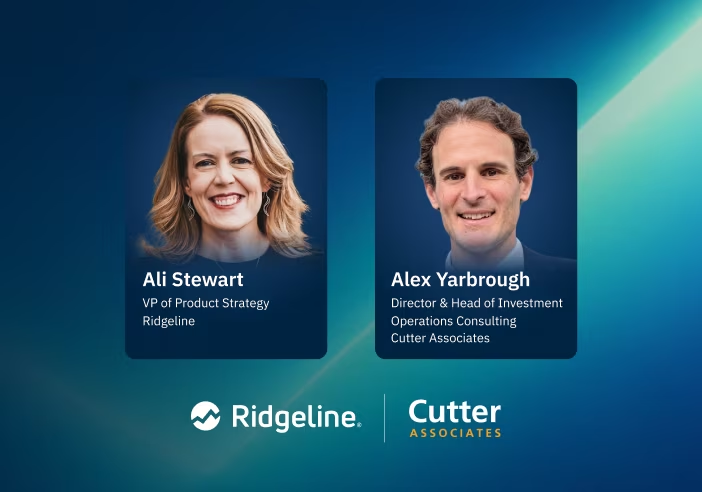

In this webinar, Ali Stewart, VP of product strategy at Ridgeline, and Alex Yarbrough, director and head of investment operations consulting at Cutter Associates, discuss how firms can approach transformation with a focus on data readiness, operating model efficiency, and long-term adaptability.
Key Takeaways
1. Data readiness goes beyond data quality
Data cleansing is an essential part of preparing for a technology transformation, but clean data alone doesn't guarantee success. Firms also need to understand what their data means, where it originates, how it's used, and who has authority over it.
For example, differences between an investment book of record (IBOR) and an accounting book of record (ABOR) aren't necessarily errors. Those differences may be intentional, reflecting distinct business purposes. Understanding why they exist is just as important as identifying them.
The takeaway: True data readiness combines data quality, clear definitions, and governance. Without all three, firms risk carrying existing inconsistencies and uncertainty into their new technology environment.
2. Establish data ownership and governance before implementation challenges arise
When multiple teams maintain or enrich the same data, conflicting values are inevitable. A security master, for instance, may contain updates from several teams, each serving a legitimate business need. Firms need a clearly defined authoritative source and decision-making process to resolve inconsistencies.
These ownership questions often surface during implementation design but become especially problematic during data validation and user acceptance testing, when timelines are already tight.
Establishing governance early helps firms avoid delays caused by unresolved reconciliation breaks, competing definitions, and unclear decision-making authority.
The takeaway: Identify data owners, establish authoritative sources, and define how exceptions will be resolved during transformation planning to avoid delays once implementation begins.
3. Technology transformation is an opportunity to rethink the operating model
Implementing modern technology doesn't automatically eliminate the inefficiencies embedded in existing processes.
Over time, investment management firms accumulate manual handoffs, overnight batch processes, duplicate validations, and reconciliations between disconnected systems. Recreating those workflows on a new platform may deliver a better user experience without fundamentally improving how the organization operates.
Instead, transformation provides an opportunity to evaluate which steps are still necessary. Could a reconciliation happen earlier in the process? Could multiple validations be consolidated? Could downstream teams access trusted information without waiting for an overnight batch?
The takeaway: Firms should use transformation to simplify and redesign workflows, not to replicate legacy processes on new technology.
4. Real-time operations depend on trusted, consistent data
Real-time data can help investment teams make decisions faster, but speed creates new challenges when users aren't confident in the information they're receiving.
Distributing inaccurate or inconsistent data faster doesn't improve decision-making. Before moving toward real-time operations, firms need confidence in the underlying data and transparency into how it is validated, reconciled, and shared.
A unified data foundation can help by enabling front-, middle-, and back-office teams to work from consistent information, including security masters, transactions, tax lots, and positions.
The shift to real-time operations can also be incremental. Firms can start by examining existing processing dependencies and identifying opportunities to make trusted data available earlier in the day.
The takeaway: The value of real-time operations doesn’t come from simply making data move faster, but from delivering accurate, actionable information sooner.
5. AI can improve operational workflows, but strong data governance remains essential
AI introduces new opportunities to identify data anomalies, surface insights, and reduce the manual effort required to monitor investment operations.
For example, AI can help teams recognize unusual patterns in performance data and flag potential issues before they affect downstream reporting or decision-making.
But identifying an anomaly is only part of the process. Firms also need clear reason codes, established resolution procedures, and human oversight to determine what action should follow.
As AI becomes part of daily operations, firms have an opportunity to reconsider how responsibilities are divided between technology and their teams.
The takeaway: AI is most effective when built on a foundation of trusted data, well-defined processes, and human judgment. Its value extends beyond detecting issues to helping teams address them more efficiently.
6. Measure transformation by adaptability, not just efficiency
Cost savings, productivity improvements, and operational efficiencies are common drivers of technology transformation. But a successful transformation should also make a firm better equipped to respond to future business needs.
Consider a firm expanding into a new geography, adding an asset class, or introducing a private markets strategy. Historically, supporting that expansion might have required new systems, additional integrations, or significant operational changes.
With a flexible operating model and strong data foundation, firms may be able to accommodate new strategies and products without undertaking another major technology project.
This adaptability also matters as technology evolves. Firms need the capacity to incorporate new functionality and continuously improve their operations without repeating a full-scale transformation.
The takeaway: The long-term value of transformation lies in creating an operating model that can support growth, absorb complexity, and adapt as business requirements change.
7. Transformation success extends well beyond go-live
Going live on time and within budget is important, but those milestones don't necessarily indicate whether a transformation delivered its intended business value.
Firms should establish success measures at the outset that reflect how their operations will improve after implementation.
Meaningful indicators include:
- Fewer reconciliations and manual workarounds: Are teams spending less time resolving discrepancies between systems?
- Greater confidence in data: Are users relying on shared information rather than independently validating the same numbers?
- More time for higher-value work: Can teams shift their attention from data troubleshooting to analysis, insights, and supporting investment decisions?
- Faster, more transparent workflows: Is actionable information reaching stakeholders earlier, with better visibility into processing status?
- Greater operational flexibility: Can the firm accommodate new business requirements without significant additional complexity?
Measuring these outcomes should continue after go-live. Periodic check-ins can help identify whether teams are reverting to old spreadsheets or manual processes, where additional improvements are needed, and how new capabilities can deliver further value.
The takeaway: Transformation is an ongoing process. Lasting success depends on sustained adoption, continuous improvement, and measurable changes in how the firm operates.
Download the white paper to learn more.
Read Next

Does Your AI Model Choice Even Matter? Why the AI Harness is the More Valuable Investment
Learn how a company-owned harness can create an enduring AI advantage through proprietary context, governance, and learning.
Customer Q&A: How Wasatch Is Rethinking How Work Gets Done With Ridgeline
Wasatch COO Hollie Strasburg and Director of Technology Jed Williams share why they left 30 years of legacy technology behind, and what they're building toward with Ridgeline.

Are You Prepared for the Advisor Mass Exodus?
With veteran advisors retiring in waves and next-generation talent increasingly difficult to recruit and retain, discover how your firm can win the war for talent.


